
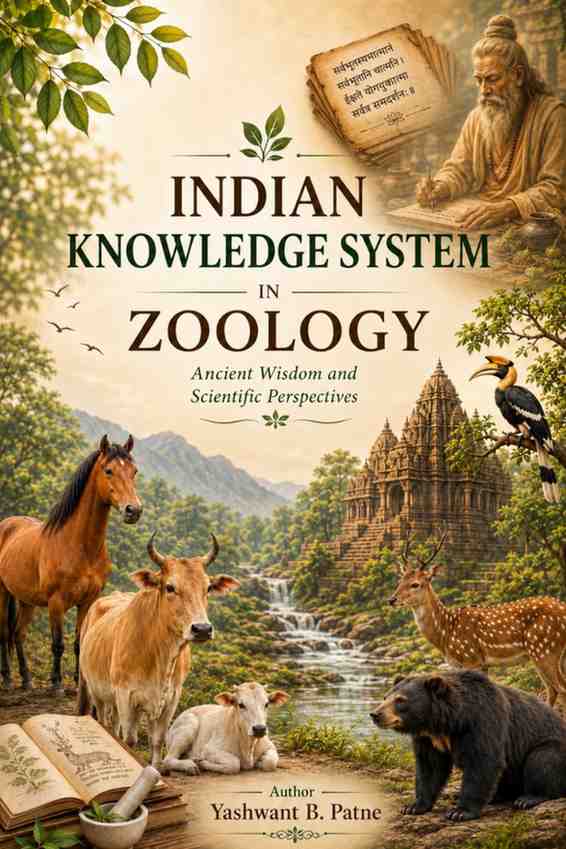
Indian Knowledge System in Zoology : Ancient Wisdom and Scientific Perspectives
| Duration: | 14 Months |
|---|---|
| Book Pages: | 128 |
| E-Book Price: |
₹ 29
|
|---|---|
| Physical Book Price: |
₹ 130
|
| E-Book Buy Date: |
--
|
|---|---|
| E-Book Expiry Date: |
--
|
| Audio Buy Date: |
--
|
| Audio Expiry Date: |
--
|
This book, Indian Knowledge System in Zoology : Ancient Wisdom and Scientific Perspectives, has been written for students, teachers, researchers, and all zoology enthusiasts. India has a rich tradition of observing, understanding, and conserving animal life. Long before modern zoology emerged as a scientific discipline, Indian scholars, sages, physicians, farmers, and tribal communities had developed valuable knowledge about animals. This knowledge is preserved in ancient texts such as the Vedas, Puranas, Ramayana, Mahabharata, Arthashastra, Ayurveda, Shalihotra Samhita, Hastyayurveda, Mrigapakshi Shastra, and in many folk traditions. To help readers better understand this rich heritage, the book also includes ancient sculptures, cave paintings, inscriptions, coins, manuscripts and other historical illustrations as visual aids wherever appropriate.
The main aim of this book is to bring together this valuable knowledge in a single, well-organized volume. It introduces the fundamentals of the Indian Knowledge System and explains its relevance to zoology. The book covers topics such as animal knowledge in ancient Indian texts, ethnozoology and traditional practices, animal healthcare, biodiversity, conservation, and ethical perspectives. Every effort has been made to present the subject in simple and easy-to-understand language. Technical and Sanskrit terms have been explained wherever necessary, and examples are mainly drawn from Indian animals and Indian knowledge traditions. The content is arranged in a systematic manner to help readers understand the subject clearly.
Contents
1. Indian Knowledge Systems (IKS)
1.1 Introduction to Indian Knowledge Systems (IKS) Concept and scope of IKS
1.2 Historical development of biological knowledge in India
1.3 Overview of ancient texts related to zoology (e.g., Vedas, Puranas, classical literature)
1.4 Basic principles of life sciences in Indian tradition
2. Animal Knowledge in Ancient Indian Texts
2.1 Animal Knowledge in Ancient Indian Texts. Classification of animals in ancient India
2.2 Study of animals in texts like Arthashastra and Ayurveda
2.3 Domestication and utility of animals
2.4 Role of animals in ancient times
3. Ethnozoology and Traditional Practices
3.1 Ethnozoology and Traditional Practices Concept of Ethnozoology
3.2 Indigenous knowledge of animal behavior and ecology Use of animals in traditional medicine and culture
3.3 Ancient Treatment Methods for Various Diseases
3.4 Human-animal relationships in tribal and rural India Integration with Modern Science
4. Conservation and Ethical Perspectives
4.1 Conservation and Ethical Perspectives Traditional conservation practices (sacred groves, animal worship)
4.2 Biodiversity conservation in Indian traditions
4.3 Animal ethics and welfare in Indian philosophy (Ahimsa concept)
4.4 Relevance of IKS in modern conservation biology

- --
- --
Book Name : Indian Knowledge System in Zoology : Ancient Wisdom and Scientific Perspectives
Author : Asst. Professor Yashwant B. Patne
Department of Zoology Mahatma Basweshwar College, Latur (M.S.)
ISBN 978-93-6342-034-2
Copyright Author 2026
First Editon: 25 July 2026
Submit Your Review
More Related Books
More Books
तुझ्याà¤...
₹ 29
₹ 65

सामाजिà¤...
₹ 35
₹ 69
दलित...
₹ 39
₹ 99

Advanced Physics...
₹ 35
₹ 99
Field Project In...
Free
Diversity of...
₹ 30
₹ 60
Indian Knowledge...
₹ 29
₹ 40

Design Your Dream...
₹ 40
₹ 50

वैदिक...
₹ 48
₹ 60

Current Trends in...
Free
समाजशाà¤...
₹ 33
₹ 49

सामाजिà¤...
₹ 29
₹ 39

कृषी...
₹ 29
₹ 39
भारतीय...
₹ 29
₹ 39

मानवी...
₹ 29
₹ 39

प्रभुरà¤...
₹ 24
₹ 30
My Statistics NEP...
₹ 35
₹ 48

व्यावसà¤...
₹ 29
₹ 48

Medicinal Chemistry...
₹ 49
₹ 60
Yashwant Patne 02-Oct-2026 07:17 am