Physics

Course: Science eDictionary
Duration: 20 Months

Dictionary Price:
₹ 39 ₹ 60 (35% Off)
Dictionary Buy Date:
--
Dictionary Expiry Date:
--


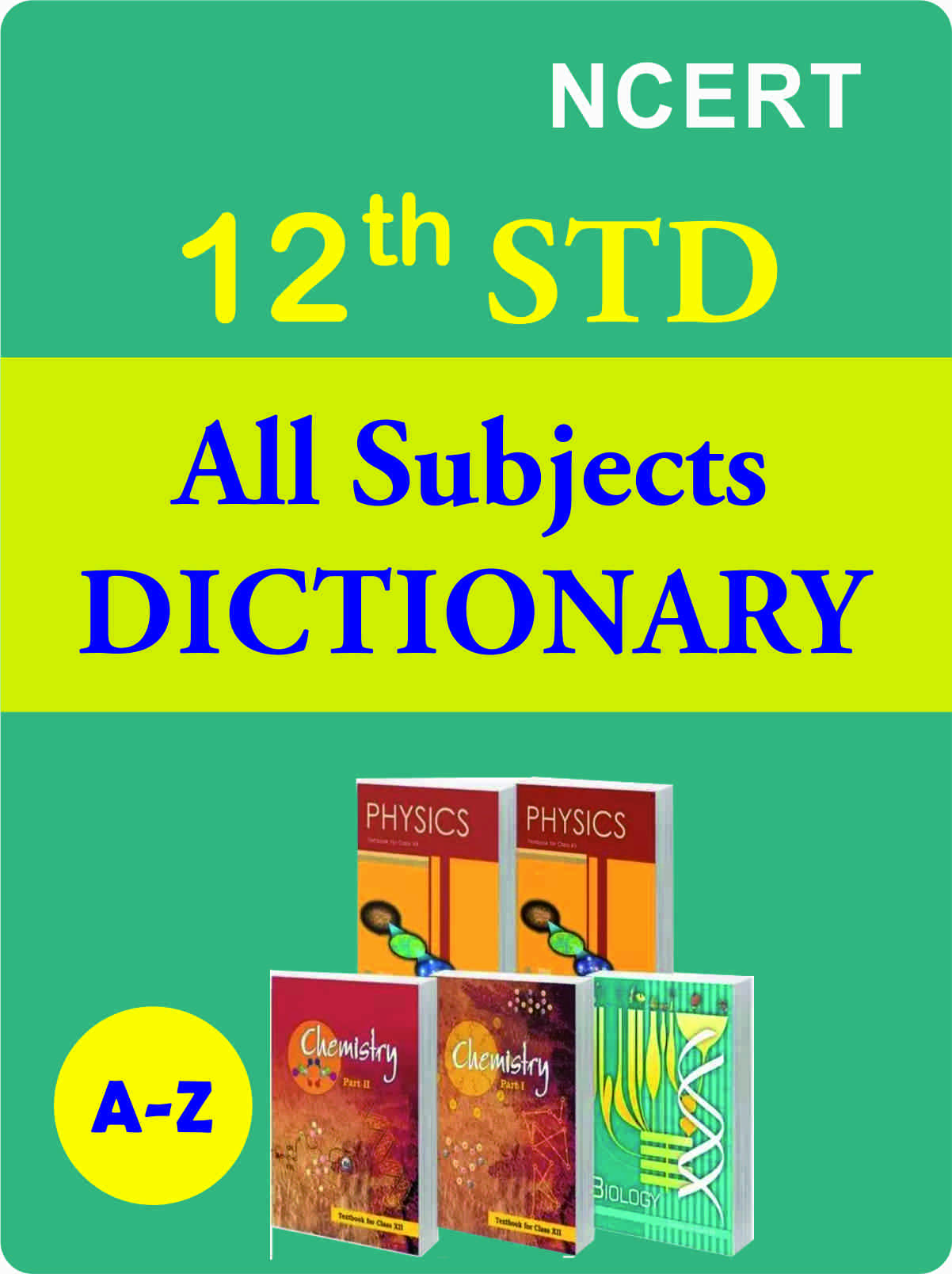
12th Physics  (Part I & II) eDictionary


- Language - (English - English - Hindi)

- A to Z all words are included

- Line to line NCERT words Meaning Explained

- Total Words - 6100+

- Simple User  Interface 

- Duration - 1 year +

- How to check the Sample of eDictionary - Download Application 

- Use in Android Application   

https://play.google.com/store/apps/details?id=com.awaysoft.prabhakar )


* About Physics eDictionary


Key Features:


  • Comprehensive Coverage: Includes all key terms, concepts, and definitions from the 12th standard physics curriculum.
  • User-Friendly Interface: Easy to navigate, allowing you to find information quickly.
  • Interactive Diagrams: Visualize complex concepts with interactive diagrams and illustrations.
  • Exam-Focused Content: Tailored content that aligns with the latest syllabus and exam patterns.
  • Search Functionality: Instantly find the terms or topics you need with an advanced search feature.
  • Regular Updates: Stay ahead with regular content updates reflecting the latest changes in the curriculum.


Why Choose Our eDictionary?


  • Portable and Accessible: Study anytime, anywhere on your preferred device.
  • Saves Time: Quickly clarify doubts and reinforce learning without the need to flip through multiple books.
  • Expertly Curated: Content created by experienced educators with a deep understanding of the subject matter.

Whether you're revising for your board exams or preparing for entrance tests like JEE or NEET, the 12th Standard Physics eDictionary is an essential tool in your academic arsenal. Don't just study physics—master it!


* Syllabus


PART I

CHAPTER ONE - ELECTRIC CHARGES AND FIELDS


1.1 Introduction 
1.2 Electric Charge 
1.3 Conductors and Insulators 
1.4 Basic Properties of Electric Charge 
1.5 Coulomb’s Law 
1.6 Forces between Multiple Charges 
1.7 Electric Field 
1.8 Electric Field Lines 
1.9 Electric Flux 
1.10 Electric Dipole 
1.11 Dipole in a Uniform External Field 
1.12 Continuous Charge Distribution 
1.13 Gauss’s Law 
1.14 Applications of Gauss’s Law 


CHAPTER TWO - ELECTROSTATIC POTENTIAL AND CAPACITANCE


2.1 Introduction 
2.2 Electrostatic Potential 
2.3 Potential due to a Point Charge 
2.4 Potential due to an Electric Dipole 
2.5 Potential due to a System of Charges 
2.6 Equipotential Surfaces 
2.7 Potential Energy of a System of Charges 
2.8 Potential Energy in an External Field 
2.9 Electrostatics of Conductors 
2.10 Dielectrics and Polarisation 
2.11 Capacitors and Capacitance 
2.12 The Parallel Plate Capacitor 
2.13 Effect of Dielectric on Capacitance 
2.14 Combination of Capacitors 
2.15 Energy Stored in a Capacitor 


CHAPTER THREE - CURRENT ELECTRICITY


3.1 Introduction 
3.2 Electric Current 
3.3 Electric Currents in Conductors 
3.4 Ohm’s law 
3.5 Drift of Electrons and the Origin of Resistivity 
3.6 Limitations of Ohm’s Law 
3.7 Resistivity of Various Materials 
3.8 Temperature Dependence of Resistivity 
3.9 Electrical Energy, Power 
3.10 Cells, emf, Internal Resistance 
3.11 Cells in Series and in Parallel 
3.12 Kirchhoff’s Rules 
3.13 Wheatstone Bridge 


CHAPTER FOUR - MOVING CHARGES AND MAGNETISM


4.1 Introduction 
4.2 Magnetic Force 
4.3 Motion in a Magnetic Field 
4.4 Magnetic Field due to a Current Element, Biot-Savart Law 
4.5 Magnetic Field on the Axis of a Circular Current Loop 
4.6 Ampere’s Circuital Law 
4.7 The Solenoid 
4.8 Force between Two Parallel Currents, the Ampere 
4.9 Torque on Current Loop, Magnetic Dipole 
4.10 The Moving Coil Galvanometer 


CHAPTER FIVE - MAGNETISM AND MATTER


5.1 Introduction 
5.2 The Bar Magnet 
5.3 Magnetism and Gauss’s Law 
5.4 Magnetisation and Magnetic Intensity 
5.5 Magnetic Properties of Materials 


CHAPTER SIX - ELECTROMAGNETIC INDUCTION


6.1 Introduction 
6.2 The Experiments of Faraday and Henry 
6.3 Magnetic Flux 
6.4 Faraday’s Law of Induction 
6.5 Lenz’s Law and Conservation of Energy 
6.6 Motional Electromotive Force 
6.7 Inductance 
6.8 AC Generator 


CHAPTER SEVEN - ALTERNATING CURRENT


7.1 Introduction 
7.2 AC Voltage Applied to a Resistor 
7.3 Representation of AC Current and Voltage by
Rotating Vectors — Phasors 
7.4 AC Voltage Applied to an Inductor 
7.5 AC Voltage Applied to a Capacitor 
7.6 AC Voltage Applied to a Series LCR Circuit 
7.7 Power in AC Circuit: The Power Factor 
7.8 Transformers 


CHAPTER EIGHT - ELECTROMAGNETIC WAVES


8.1 Introduction 
8.2 Displacement Current 
8.3 Electromagnetic Waves 
8.4 Electromagnetic Spectrum

PART II

CHAPTER NINE  - RAY OPTICS AND OPTICAL INSTRUMENTS


9.1 Introduction 
9.2 Reflection of Light by Spherical Mirrors 
9.3 Refraction 
9.4 Total Internal Reflection 
9.5 Refraction at Spherical Surfaces and by Lenses 
9.6 Refraction through a Prism 
9.7 Optical Instruments 


CHAPTER TEN - WAVE OPTICS


10.1 Introduction 
10.2 Huygens Principle 
10.3 Refraction and Reflection of Plane Waves using Huygens Principle 
10.4 Coherent and Incoherent Addition of Waves 
10.5 Interference of Light Waves and Young’s Experiment 
10.6 Diffraction 
10.7 Polarisation 


CHAPTER ELEVEN - DUAL NATURE OF RADIATION AND MATTER


11.1 Introduction 
11.2 Electron Emission 
11.3 Photoelectric Effect 
11.4 Experimental Study of Photoelectric Effect 
11.5 Photoelectric Effect and Wave Theory of Light 
11.6 Einstein’s Photoelectric Equation: Energy Quantum of Radiation 
11.7 Particle Nature of Light: The Photon 
11.8 Wave Nature of Matter 


CHAPTER TWELVE - ATOMS


12.1 Introduction 
12.2 Alpha-particle Scattering and Rutherford’s Nuclear Model of Atom 
12.3 Atomic Spectra 
12.4 Bohr Model of the Hydrogen Atom 
12.5 The Line Spectra of the Hydrogen Atom 
12.6 DE Broglie’s Explanation of Bohr’s Second Postulate of Quantisation 


CHAPTER THIRTEEN - NUCLEI


13.1 Introduction 
13.2 Atomic Masses and Composition of Nucleus 
13.3 Size of the Nucleus 
13.4 Mass-Energy and Nuclear Binding Energy 
13.5 Nuclear Force
13.6 Radioactivity 
13.7 Nuclear Energy 


CHAPTER FOURTEEN - SEMICONDUCTOR ELECTRONICS: MATERIALS, DEVICES AND SIMPLE CIRCUITS


14.1 Introduction 
14.2 Classification of Metals, Conductors and Semiconductors 
14.3 Intrinsic Semiconductor 
14.4 Extrinsic Semiconductor 
14.5 p-n Junction 
14.6 Semiconductor Diode 
14.7 Application of Junction Diode as a Rectifier


0

Average Rating

0%Recommended

Submit Your Review

Product

Chemistry

₹ 49 ₹ 70
Product

Physics

₹ 39 ₹ 60
Product

Biology

₹ 59 ₹ 80
Product

Physics

₹ 39 ₹ 60
Product

Chemistry

₹ 49 ₹ 70
Product

Biology

₹ 59 ₹ 80
Product
Product
Product
Product