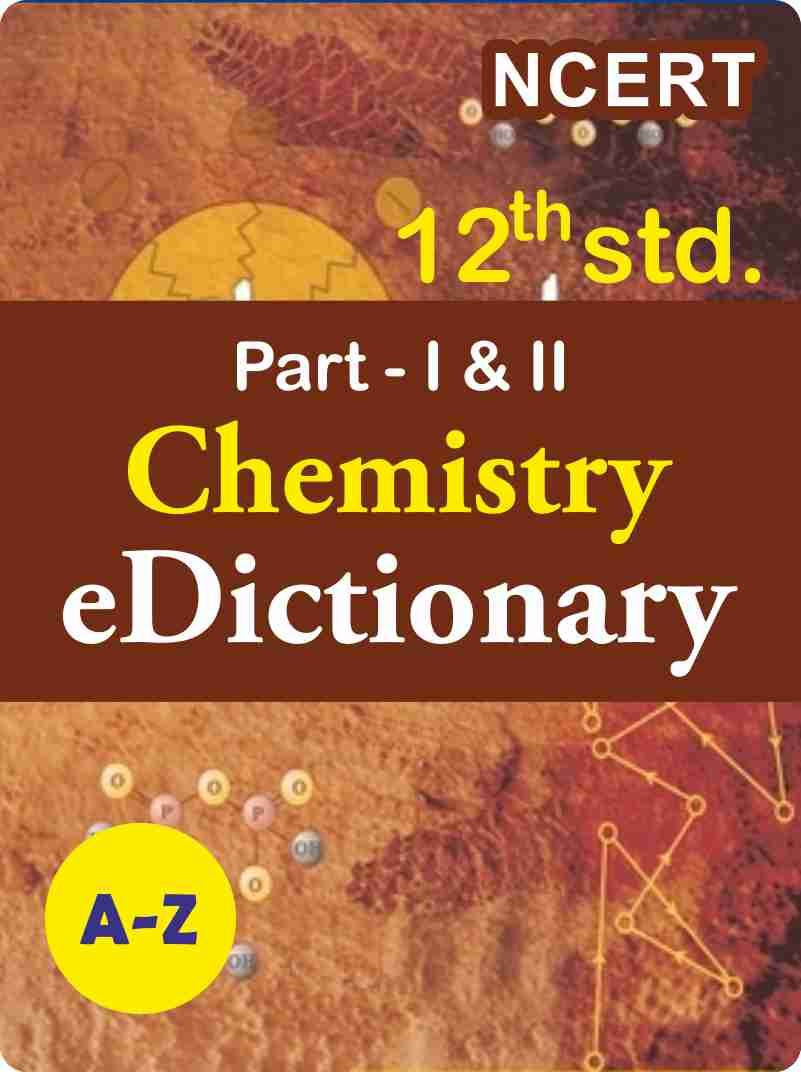
Chemistry

Course: Science eDictionary
Duration: 20 Months

Dictionary Price:
₹ 49 ₹ 70 (30% Off)
Dictionary Buy Date:
--
Dictionary Expiry Date:
--


12th Chemistry  (Part I & II) eDictionary


- Language - (English - English - Hindi)

- A to Z all words are included

- Line to line NCERT words Meaning Explained

- Total  Words - 6100+

- Simple User  Interface 

- Duration - 1 year +

- How to check the Sample of eDictionary - Download Application 

- Use in Android Application   

https://play.google.com/store/apps/details?id=com.awaysoft.prabhakar )


About this eDictionary


- Bilingual English-English-Hindi definitions for better understanding.


- Aligned with NCERT syllabus for exam preparation.


- User-friendly interface with quick search functionality.


- Offline access for study anytime, anywhere.


- Includes examples and explanations for practical understanding.


- Ideal for quick revision and board exam preparation.


- Digital, portable, and optimized for Android devices.


* Syllabus


PART I

Unit 1 Solutions 

1.1 Types of Solutions 
1.2 Expressing Concentration of Solutions 
1.3 Solubility 
1.4 Vapour Pressure of Liquid Solutions
1.5 Ideal and Non-ideal Solutions 
1.6 Colligative Properties and Determination of Molar Mass 
1.7 Abnormal Molar Masses 

Unit 2 Electrochemistry 

2.1 Electrochemical Cells 
2.2 Galvanic Cells 
2.3 Nernst Equation 
2.4 Conductance of Electrolytic Solutions 
2.5 Electrolytic Cells and Electrolysis 
2.6 Batteries 
2.7 Fuel Cells 
2.8 Corrosion 

Unit 3 Chemical Kinetics 

3.1 Rate of a Chemical Reaction 
3.2 Factors Influencing Rate of a Reaction 
3.3 Integrated Rate Equations 
3.4 Temperature Dependence of the Rate of a Reaction 
3.5 Collision Theory of Chemical Reactions 

Unit 4 The d-and f-Block Elements 

4.1 Position in the Periodic Table
4.2 Electronic Configurations of the d-Block Elements 
4.3 General Properties of the Transition Elements (d-Block)
4.4 Some Important Compounds of Transition Elements 
4.5 The Lanthanoids 
4.6 The Actinoids 
4.7 Some Applications of d- and f-Block Elements 

Unit 5 Coordination Compounds 

5.1 Werner's Theory of Coordination Compounds 
5.2 Definitions of Some Important Terms Pertaining to Coordination Compounds
5.3 Nomenclature of Coordination Compounds
5.4 Isomerism in Coordination Compounds
5.5 Bonding in Coordination Compounds
5.6 Bonding in Metal Carbonyls
5.7 Importance and Applications of Coordination Compounds

PART II

Unit 6 Haloalkanes and Haloarenes 

6.1 Classification 
6.2 Nomenclature 
6.3 Nature of C–X Bond 
6.4 Methods of Preparation of Haloalkanes 
6.5 Preparation of Haloarenes 
6.6 Physical Properties 
6.7 Chemical Reactions 
6.8 Polyhalogen Compounds 

Unit 7 Alcohols, Phenols and Ethers 

7.1 Classification 
7.2 Nomenclature 
7.3 Structures of Functional Groups 
7.4 Alcohols and Phenols 
7.5 Some Commercially Important Alcohols 
7.6 Ethers 

Unit 8 Aldehydes, Ketones and Carboxylic Acids 

8.1 Nomenclature and Structure of Carbonyl Group 
8.2 Preparation of Aldehydes and Ketones 
8.3 Physical Properties 
8.4 Chemical Reactions 
8.5 Uses of Aldehydes and Ketones 
8.6 Nomenclature and Structure of Carboxyl Group 
8.7 Methods of Preparation of Carboxylic Acids 
8.8 Physical Properties 
8.9 Chemical Reactions 
8.10 Uses of Carboxylic Acids 

Unit 9 Amines 

9.1 Structure of Amines 
9.2 Classification 
9.3 Nomenclature 
9.4 Preparation of Amines 
9.5 Physical Properties
9.6 Chemical Reactions 
9.7 Method of Preparation of Diazonium Salts 
9.8 Physical Properties 
9.9 Chemical Reactions 
9.10 Importance of Diazonium Salts in Synthesis of Aromatic Compounds

Unit 10 Biomolecules 

10.1 Carbohydrates 
10.2 Proteins 
10.3 Enzymes 
10.4 Vitamins 
10.5 Nucleic Acids
10.6 Hormones 


0

Average Rating

0%Recommended

Submit Your Review

Product

Chemistry

₹ 49 ₹ 70
Product

Physics

₹ 39 ₹ 60
Product

Biology

₹ 59 ₹ 80
Product

Physics

₹ 39 ₹ 60
Product

Chemistry

₹ 49 ₹ 70
Product

Biology

₹ 59 ₹ 80
Product
Product
Product
Product